
Microchip ATF16V8B-10JU: A Comprehensive Technical Overview
The Microchip ATF16V8B-10JU stands as a prominent member of the classic yet enduring family of Programmable Logic Devices (PLDs). This device encapsulates the flexibility of programmable logic in a low-power, high-performance CMOS solution, making it a reliable choice for a vast array of digital logic applications, from simple glue logic to state machine control.
Architecture and Core Functionality
At its heart, the ATF16V8B-10JU is a 24-pin, high-performance CMOS PLD organized around a programmable AND array and a fixed OR array, a structure famously known as the PAL® architecture. The "16V8" designation indicates it features 8 fully configurable output logic macrocells (OLMCs), each of which can be independently configured for combinatorial or registered operation. These macrocells are fed by 16 input terms, providing significant logic capability for its pin count.
A key feature of this device is its electrically erasable (EE) CMOS technology. Unlike older, one-time programmable (OTP) variants, the ATF16V8B-10JU can be erased and reprogrammed, offering immense flexibility during the design, prototyping, and debugging phases. This drastically reduces development time and cost.
Performance Specifications: Decoding the -10
The suffix in the part number, "-10", directly denotes its speed grade. This critical specification indicates a maximum propagation delay (tPD) of 10ns from any input to any registered or combinatorial output. This high speed, coupled with a 100% factory-tested maximum pin-to-pin delay, ensures predictable and reliable performance in timing-critical applications. The device supports operating frequencies up to 100 MHz.
Furthermore, it boasts a low power consumption profile, typical of advanced CMOS processes. It operates on a standard 5V power supply and features a zero-power standby mode, making it suitable for power-sensitive designs.
Programming and Development
Development for the ATF16V8B-10JU is supported by a mature and robust toolchain. Engineers use industry-standard Hardware Description Languages (HDLs) like VHDL or Verilog, or simpler Boolean equations, to define the desired logic functions. These descriptions are then processed by PLD development software (e.g., WinCUPL, ATF WinISP) which handle fitting, logic optimization, and the generation of a JEDEC file. This JEDEC file is ultimately used to program the device via a standard programmer.
Key Applications
The versatility of the ATF16V8B-10JU makes it ideal for numerous functions, including:
Address decoding in microprocessor and microcontroller systems.
Implementing custom state machines and complex combinatorial logic.
Bus interfacing and protocol conversion.
Replacing multiple small-scale integration (SSI) glue logic chips, thereby reducing board space and component count.
Package and Operating Conditions
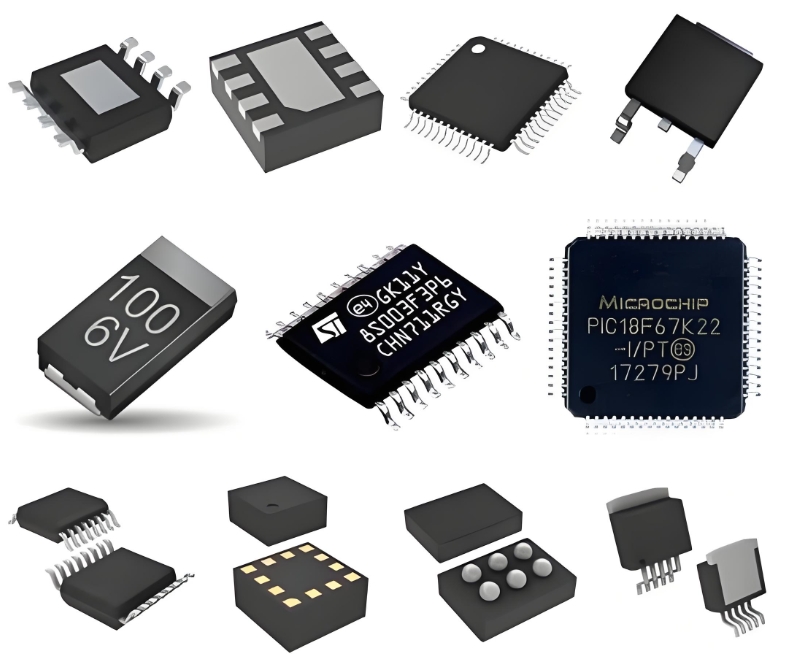
The "JU" suffix specifies the package type: a standard 24-lead Plastic J-Lead Chip Carrier (PLCC). This surface-mount package is robust and widely used. The device is designed for commercial temperature ranges (0°C to +70°C).
The Microchip ATF16V8B-10JU remains a highly effective solution for integrating digital logic. Its reprogrammability, high-speed 10ns performance, and flexible output macrocells provide a perfect blend of power, flexibility, and cost-efficiency for consolidating system logic. For engineers seeking a reliable, proven, and easy-to-use PLD for legacy support or new designs, the ATF16V8B-10JU continues to be an outstanding choice.
Keywords:
1. Programmable Logic Device (PLD)
2. 10ns Propagation Delay
3. Electrically Erasable (EE) CMOS
4. Output Logic Macrocell (OLMC)
5. JEDEC Programming

